
Dublin Airport invests €17 million in Ireland’s first pantograph chargers for electric buses
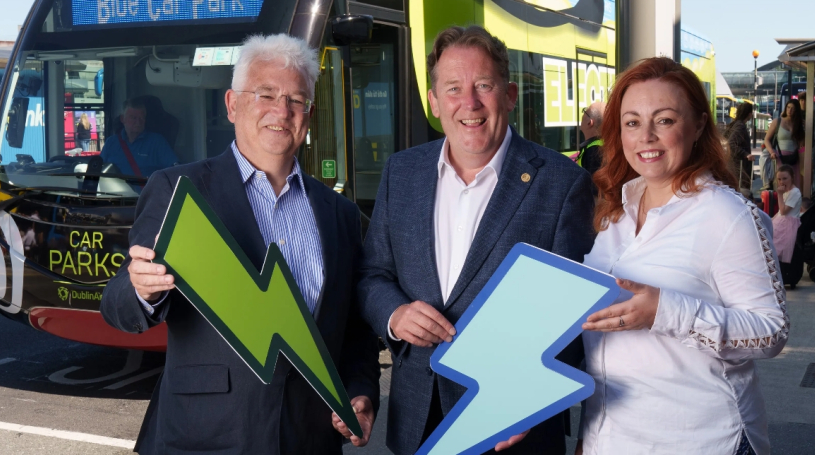
Ireland’s first cutting-edge, pantograph electric bus chargers have been unveiled at Dublin Airport in a €17 million investment in sustainable electric transport, daa announced today.
Dublin Airport’s pantograph infrastructure will deliver ultrafast charging for its new 14-vehicle, zero-emission electric shuttle bus fleet, which is operated by Aircoach and can accommodate up to 120 passengers per journey.
Pantograph charging is an automated high-power system that uses retractable charging arms to rapidly power high-frequency electric buses at the endpoint of their routes, removing the need for them to return to the depot to charge during the day.
Together, the new charging infrastructure and higher-capacity EV fleet will reduce downtime and support more reliable, efficient services for the circa 2.5 million passengers who use the service each year to travel between the airport’s car parks and terminal buildings. A separate dedicated seven-bay depot charging facility provides additional overnight and back-up charging capacity for the fleet, supporting resilience across the airport’s shuttle bus operations.
daa’s €17 million investment includes major voltage upgrades required for this system and the pantograph charging infrastructure. Part of this funding came from a €4.7 million grant from the European Commission under the Connecting Europe Facility - Alternative Fuels Infrastructure Facility (CEF AFIF). The funding is contributing to the delivery of the wider Dublin Airport Campus Electrification (DACE) programme, which includes the pantograph chargers and other EV charging infrastructure that will reduce emissions and support the transition to cleaner transport at Dublin Airport.
Aircoach, daa’s service partner, has invested €11 million in the new electric bus fleet. The transition to electric buses from diesel will save over 1470 tonnes of CO2e annually, contributing to Dublin Airport’s ambitious decarbonisation targets validated under the Science Based Targets Initiative (SBTi). The new fleet is now operational at Dublin Airport.
Welcoming the development, Minister for Transport Darragh O’Brien, said: “It is encouraging to see daa continuing to invest in sustainable travel and renewable energy solutions. Aviation is one of the hardest sectors to decarbonise and every initiative that helps reduce the impact of passenger travel is important. I was pleased to visit the airport recently to see the pantograph charging infrastructure in action, located close to the site of Dublin Airport’s future MetroLink station, which will also make a significant contribution to the decarbonisation of passenger travel.”
Commenting, Vincent Harrison, daa Chief Commercial and Development Officer, said: “Dublin Airport is delighted to be the first location in Ireland to harness the benefits of fast, pantograph charging for our electric shuttle buses. This type of charging is well suited to high-frequency fixed routes, enabling smaller batteries and fast ‘opportunity’ charging instead of lengthy depot charging. This means cleaner, quieter and more reliable journeys for passengers. Our investment in this infrastructure also helps to future-proof Dublin Airport and advance our sustainability ambitions.”
Commenting, Andrea Carroll, daa Director of Sustainability, said: “Dublin Airport is now among the top 13% of airports globally to have received certification at ACA Level 4+ for carbon management* but we are not resting on our laurels. Decarbonising our airport vehicles is a key part of daa’s ambitious sustainability strategy. The conversion to electric fleet will reduce the carbon impact of passenger journeys to and from the airport, complementing other initiatives across the airport campus and increasing the resilience of our fleet.”
Kim Swan, Managing Director of Aircoach, commented: “We are delighted to introduce and operate a new fleet of electric buses across the Dublin Airport car park shuttle service, reinforcing Aircoach’s commitment to delivering operational excellence while supporting our broader environmental objectives. The distinctive look of the buses, featuring bright colours and a friendly caterpillar design, also bring a sense of fun that we hope will appeal to passengers as they head to and from their holidays this summer.”
Additional sustainability initiatives
The deployment of energy efficient technology across the campus remains a key part of the airport’s carbon reduction strategy, with the ongoing deployment of LED lighting, fixed electrical ground power (FEGP) for aircraft and electric vehicle (EV) fleet and charging point upgrades among other solutions.
82% of Dublin Airport’s light commercial fleet (e.g. cars and vans) have transitioned to LEV (low emission vehicles) and are electric or hybrid vehicles, and 100% of the heavy fleet (e.g. fire and rescue trucks) have transitioned from diesel to Hydrotreated Vegetable Oil (HVO) or electric.
Dublin Airport also continues to support its aviation and transport partners to find ways to reduce their carbon emissions (Scope 3), which are outside of Dublin Airport’s direct control. These emissions emanate from many sources including aircraft flight emissions and passenger transport to and from the airport. Dublin Airport is supporting its airline customers’ exploration of sustainable aviation fuels and the possibilities of hydrogen and electricity powered flight.
It is also supportive of ambitious public infrastructure projects including MetroLink and BusConnects, which will reduce passenger emissions as they travel to and from Dublin Airport. The tender to build Dublin Airport’s MetroLink stop was issued in May by MetroLink, and the airport continues to work collaboratively with MetroLink and other stakeholders including the NTMA, TII and FCC to progress these plans.